








.png)









TreeAMS - How to Measure Multi-Outlet Performance: Building a Scorecard That Drives Results
Vietnam’s franchise sector grew nearly 19% last year. As regional networks expand, performance scorecards help franchisors track financial and operational gaps across outlets.
Southeast Asia's franchise and multi-outlet sector is expanding fast. Franchise Asia’s 2026 regional outlook estimates that the region’s franchise market will reach nearly US$78 billion by the end of 2026, with annual growth of around 12%, outpacing North America and Western Europe. Vietnam, Indonesia, and the Philippines are leading this expansion, each adding outlets faster than the regional average.
At this growth rate, operational problems can build up before operators notice them. Financial performance alone cannot tell a franchisor whether a unit is actually healthy. A unit can hit its revenue target while its audit scores slip, its training records fall behind, and its checklist compliance drops, and none of that shows up until the next financial report, by which point the damage has compounded.
To manage growth well, franchisors need visibility into financial and operational performance together, on a single view, at the pace the business is actually moving. This is what a Performance Scorecard is built to do.
What Is a Performance Scorecard?
A Performance Scorecard is a tool for franchisors, franchise managers, and multi-outlet business owners to monitor and evaluate outlet performance. It works much like a report card: a single view of a unit's overall health that shows an operator exactly where improvement is needed. This gives them one clear view, without piecing together information from multiple reports.
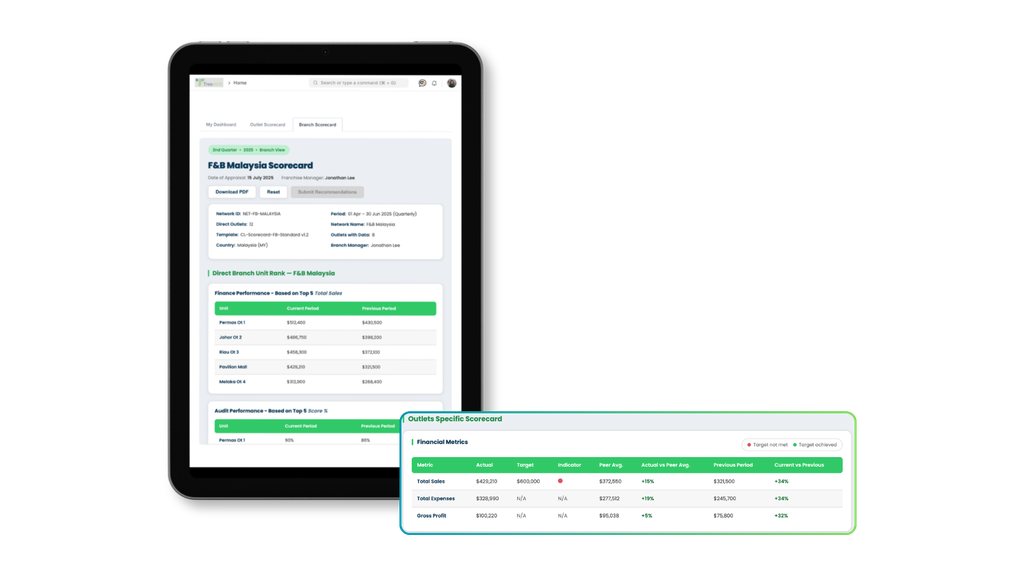
A scorecard tracks KPIs relevant to the business model, like revenue, operational execution, and growth targets. With the TreeAMS Performance Scorecard, each outlet's performance is measured against two references: a set target, and the average performance of its group. This comparison is available at four levels (individual, outlet, group, or brand), so a franchisor can trace a result from the brand level down to the specific outlet or person driving it.
These four levels answer where to look. The three perspectives below show what can be examined at each level.
Practical Applications of a Performance Scorecard
For a scorecard to be useful, it needs a balanced view that considers more than financial performance alone. Below are three practical lenses to build it around.
The Customer Perspective
- Quality Assurance: Setting clear quality goals lets a franchisor confirm every outlet meets the same product and service standard. Rather than occasional checks, the scorecard tracks this consistently and flags where a specific outlet is falling short.
- Cost Control: Tracking cost metrics from the customer's side shows whether an outlet is still offering competitive pricing and value. The scorecard tracks these expenses over time at the outlet level, so issues are identified before they affect the customer experience.
- Performance and Service Tracking: Setting service standards keeps the customer experience consistent across the network. The scorecard tracks these metrics and shows exactly where an outlet needs to improve, rather than leaving the franchisor to rely on customer complaints as the first signal.
Regular monitoring requires an audit plan, which is normally time-consuming for franchise managers to run manually. Franchise management technology removes most of that manual work, like scheduling audits, collecting results, and reporting outcomes automatically. It gives managers more time to act on findings rather than gather information.
Managed well, this perspective keeps the brand experience consistent for the customer, at every outlet, regardless of who is running it that day.
Engagement, Learning, and Compliance Perspective
- Engagement and Communication: A scorecard gives franchise managers a factual basis for conversations with franchisees. Monitoring shared metrics makes it possible to identify what is working and what isn't, and raise it directly.
- Identifying Opportunities for Improvement: Tracking performance across the network over time surfaces patterns worth investigating; a recurring gap in one region, a metric that consistently lags at a certain outlet format. These patterns point to where the business should focus its next round of improvement.
- Motivating High-Performing Franchisees: The scorecard gives franchisors a factual basis to recognize strong performers and set clear goals for continued growth, with recognition based on measurable results.
- Addressing Underperformance: When a franchisee is underperforming, the scorecard identifies where the gap actually is — training, audit, checklist, or a combination — allowing support to address the actual cause of the problem.
- Boosting Compliance: For a franchise system to grow, the franchisor has to maintain consistent brand standards across every unit. The scorecard should track compliance benchmarks against legal, health and safety, brand, human resource, and tax requirements. It helps identify gaps early, before they lead to disputes or liabilities.
A franchise system depends on the franchisor's ability to keep improving the system itself, not just the outlets running it. Using the scorecard to drive these conversations is what keeps that improvement cycle active.
Financial Perspective
- Determining Franchise Success: Financial performance is one of the clearest indicators of whether a franchise's strategy is working. The scorecard gives a franchisor a complete financial view (revenue, expenses, and profitability) for each unit.
- Franchise Unit Performance: The scorecard shows the financial health of every individual unit, so a franchisor can track and compare performance across the network without waiting for a consolidated report.
- Profit Analysis: The scorecard helps identify where profitability is falling short and why. Strong financial numbers do not always mean strong operational performance, and weak financial numbers do not always mean poor execution. This is why financial data should be read alongside audit, training, and checklist data, not on its own.
- Compare Financial Target vs. Actual: The scorecard compares budgeted targets against actual revenue, so a franchisor can spot cost-saving opportunities and control spending before it becomes a bigger problem.
- Investment Monitoring: The scorecard tracks franchisee investment against return, giving the franchisor a clear view of financial health across the network. Not just at a single unit, but across the group.
Summing It Up
A performance scorecard gives a franchisor a way to measure financial and operational performance in one place, identify where improvement is needed, and hold data-driven conversations with franchisees based on measurable evidence. Getting the most out of this tool means building it around consistent performance measurement, regular franchisee conversations grounded in data, and technology that automates the manual tracking work.
A performance scorecard is not a standalone product, it works best as part of a connected operations platform, where the data behind it (audit, training, checklist, and financial records) is already being captured consistently. The TreeAMS Performance Scorecard is built this way: it pulls from the modules a franchise network is already running, measures every outlet against its target and group average, and shows a franchisor exactly where to look, before a small problem becomes a costly one.
No comments yet. Login to start a new discussion Start a new discussion